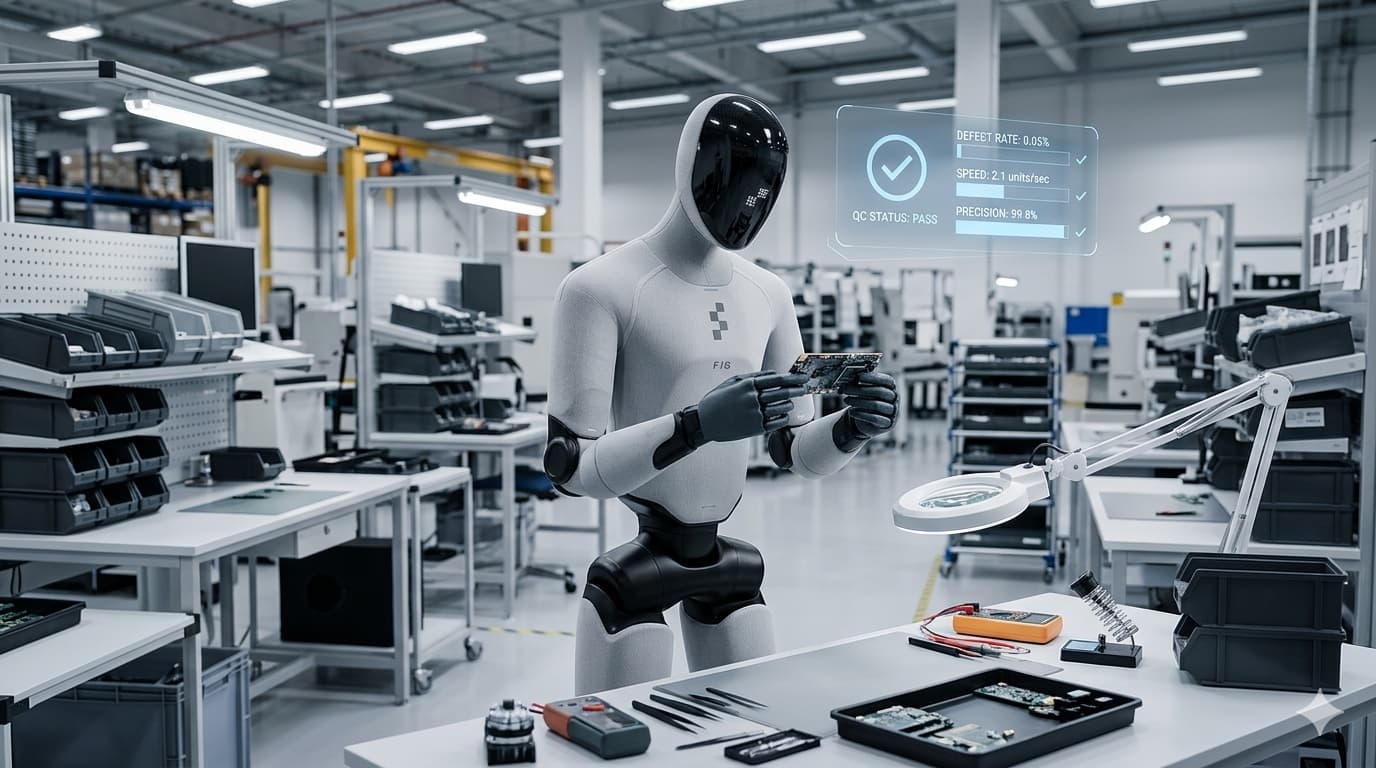
Which station should the robot do first?
HDFS gives every process a single score from 0 to 100 for humanoid automation, built from the operator videos you already have. Pick the right station with data, not a hunch.
What goes into the score
HDFS runs on top of the time studies Khenda already pulls from your operator videos. It combines three things into one number.
Stability
Cycle times, variation, predictability, and takt fit, measured automatically from time-study data.
Skill profile
Dexterity, grasp type, tool use, and how stable the environment is, all labeled automatically from the video.
Engineer context
A few things the camera can't see (payload, part criticality) are confirmed by an expert. The system pre-fills them, so it's usually just an approval.
The method
How it works
Start with video you already have
The same operator videos that feed Khenda's time-study engine also feed HDFS. No new cameras, no extra hardware.
AI reads the signals
Pose estimation reads motion and reach, object detection reads how parts and tools are handled, and a vision-language model reads things like precision grasping and quality checks.
A clear formula sets the score
The AI only observes and labels. A transparent, weighted formula turns those labels into the score, so you can always see why a station got the number it did.
You get one number, 0 to 100
Every process lands in a simple band, so the result tells you exactly what to do next.
What the score tells you
| Score | What it means |
|---|---|
| 75–100 | Ready. A good candidate for a pilot. |
| 50–74 | Maybe. Viable after some process improvement. |
| 25–49 | Hard. Needs significant re-engineering. |
| 0–24 | Not a fit. Keep the human operator. |
Why you can trust the number
No new setup
It builds on time studies Khenda already produces from your video. No data collection from scratch, no new cameras, no months-long study.
A human signs off
The AI never decides the score alone. Anything it's unsure about goes to an engineer to approve, so a person is always in the loop.
You see the math
Every score breaks down by factor. “Why did this station get 62?” always has a clear answer.
Score one of your stations
Send us video you already have, and we'll score a station for humanoid automation. See exactly where to start.
Score a Station